EmpCo Quick Check

Where are the EmpCo risks in your sustainability communication?

The Empowering Consumers Directive (EmpCo) will prohibit many common sustainability claims from September 2026. With our AI-powered Quick Check, we identify potential conflict cases in your communication—quickly, systematically, and with concrete recommendations for action.

27.09.2026

Deadline for mandatory application in Germany

EmpCo applies to all companies that advertise to or sell to consumers in the EU

Non-EU providers are also affected; only purely B2B communication is exempt

No transitional periods are предусмотрены

No need to worry—we will prepare you: Book a free initial consultation.
Contact Martin Granzow

Dr. Martin Granzow

Managing Director Founder | Nextra Consulting

Background

What is EmpCo?

The Empowering Consumers for the Green Transition Directive (EU) 2024/825 is the “sister directive” of the Green Claims Directive. Its goal: to stop greenwashing and empower consumers to make more sustainable purchasing decisions through better information.

In Germany, the directive will expand the Act Against Unfair Competition (UWG) to include specific greenwashing prohibitions. It affects websites, online shops, packaging, press releases, annual reports, and other public communication channels.

EmpCo clearly defines which types of sustainability claims will be prohibited in the future—thereby establishing a clear regulatory framework for corporate communications.

Timeline

February 2024

Adoption of the EmpCo Directive (EU) 2024/825

March 2024

Publication and entry into force at EU level

By March 2026

Member States must enact and publish implementation in national law

From September 27, 2026

Mandatory application in Germany: UWG expanded to include greenwashing prohibitions

Regulatory framework

These practices are prohibited under EmpCo

The directive addresses 7 key categories of unfair sustainability claims that are widespread in corporate communications.

Generic environmental claims

Vague terms such as “environmentally friendly,” “climate-friendly,” or “sustainable” without substantiated evidence

Incomplete environmental claims

Claims that highlight only partial aspects and omit relevant limitations

Irrelevant benefits

Highlighting environmental characteristics that do not differentiate within the product category

Legal requirements presented as a special feature

Presenting legally required standards as a voluntary sustainability achievement

Climate neutrality through offsetting

Claims such as “CO₂-neutral” or “climate-neutral” that are based exclusively on offsetting

Sustainability seals and labels

Use of non-certified seals or labels without completed third-party verification

Early obsolescence and repairability

Concealing planned obsolescence or misleading information about durability and repairability

Risks

Consequences of non-compliance

Companies risk significant sanctions—legal, financial, and reputational.

Cease-and-desist actions fines

Actors such as the Wettbewerbszentrale and Deutsche Umwelthilfe can bring cease-and-desist actions. EU Member States impose fines of up to 4% of annual turnover.

Reputational risk

Public condemnations have long-lasting effects. Consumers and investors lose trust—ESG ratings and financing terms deteriorate.

Advertising ban product withdrawal

Courts order the immediate cessation of all affected communication materials—website, packaging, advertising, investor relations.

Access to capital markets

Investors and banks increasingly demand verifiable ESG data. Inaccurate green claims jeopardise credit lines, green bond issuances, and ESG ratings.

Our approach

The EmpCo Quick Check with an AI agent

Our EmpCo Quick Check combines the efficiency of a specialized AI agent with the expert assessment of experienced sustainability consultants. The Nextra EmpCo AI agent systematically screens your public sustainability communication for potential conflict cases—across websites, online shops, press releases, annual reports, and other touchpoints. The identified claims are then professionally evaluated by our consultants, prioritized by risk indication, and provided with concrete mitigation proposals.

Process

How the Quick Check works

In five structured steps, from source selection to a handover-ready result:

1
Source selection

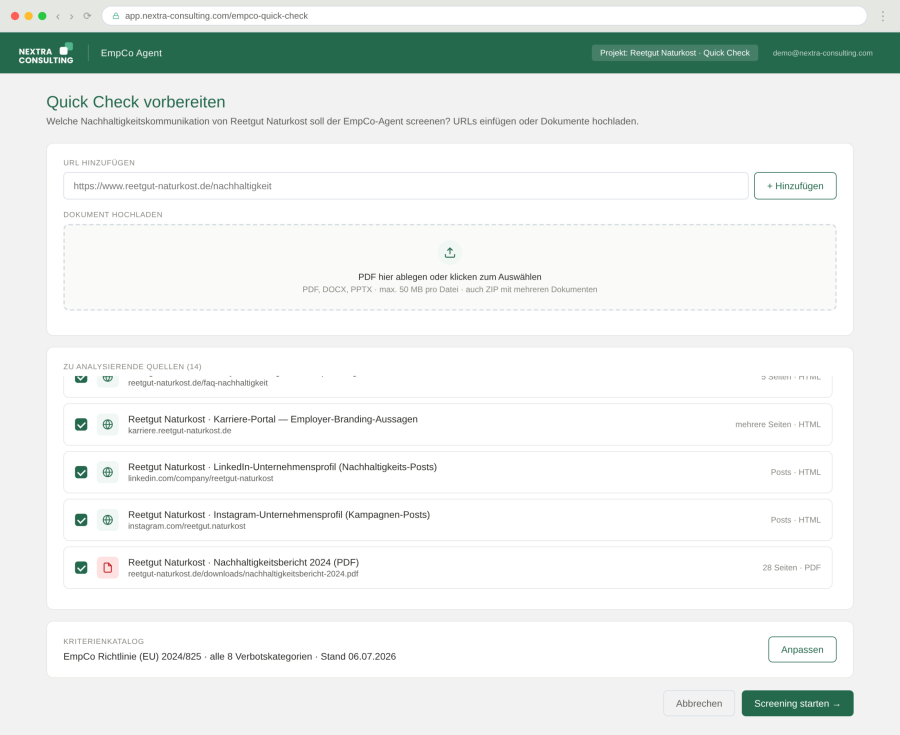
Joint definition of the sustainability touchpoints to be reviewed: website, shop, press releases, annual report, and other documents.

2
AI screening

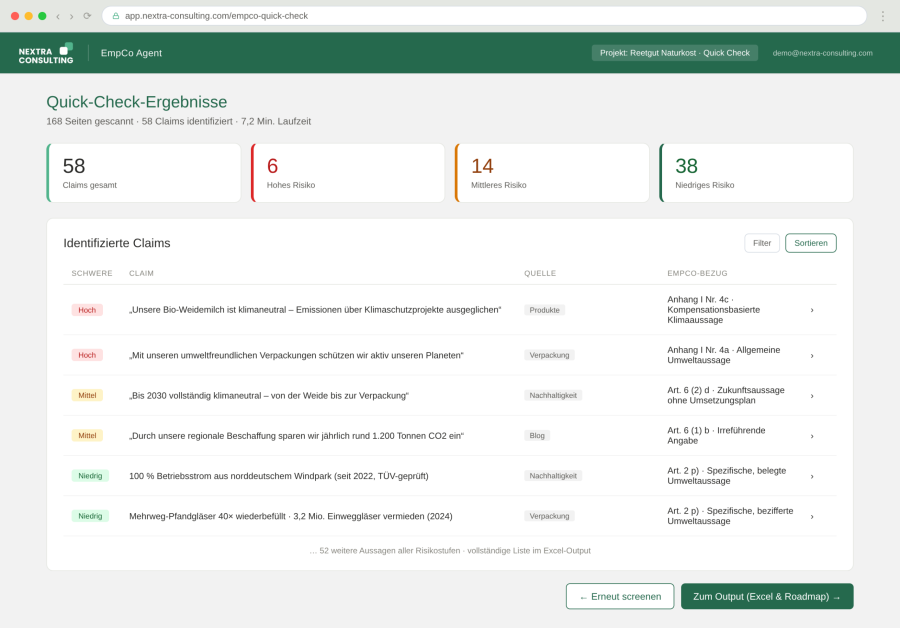
The EmpCo AI agent extracts all sustainability statements from the web and PDFs in minutes and assigns them to EmpCo topic categories to make potential conflict cases visible.

3
Risk classification

Each identified claim is prioritized for prominence from a sustainability perspective and professionally assessed by experienced consultants. High-risk cases are prioritized.

4
Claim analysis

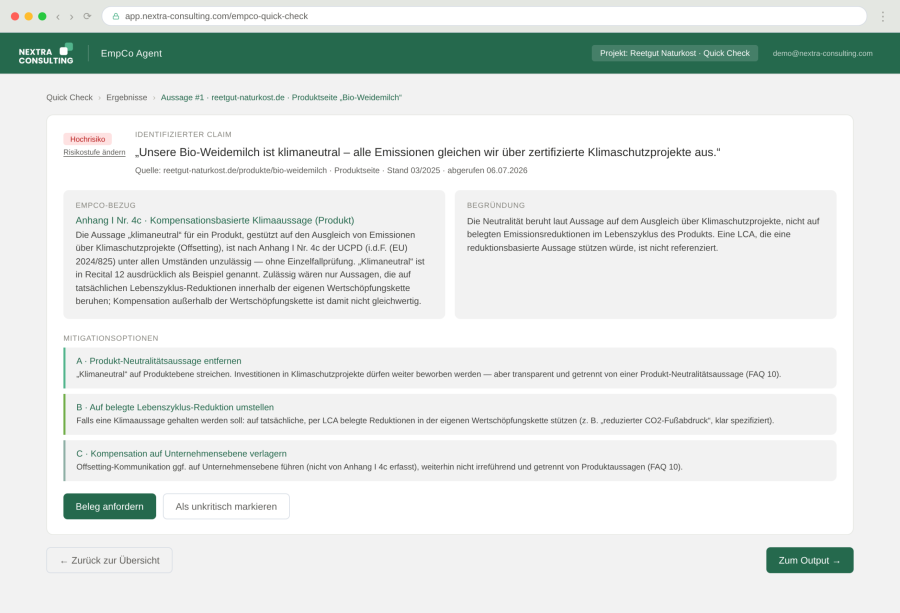
Per hit: original wording, EmpCo reference, three tiered strategic action options, and a pre-filled evidence request.

5
Result roadmap

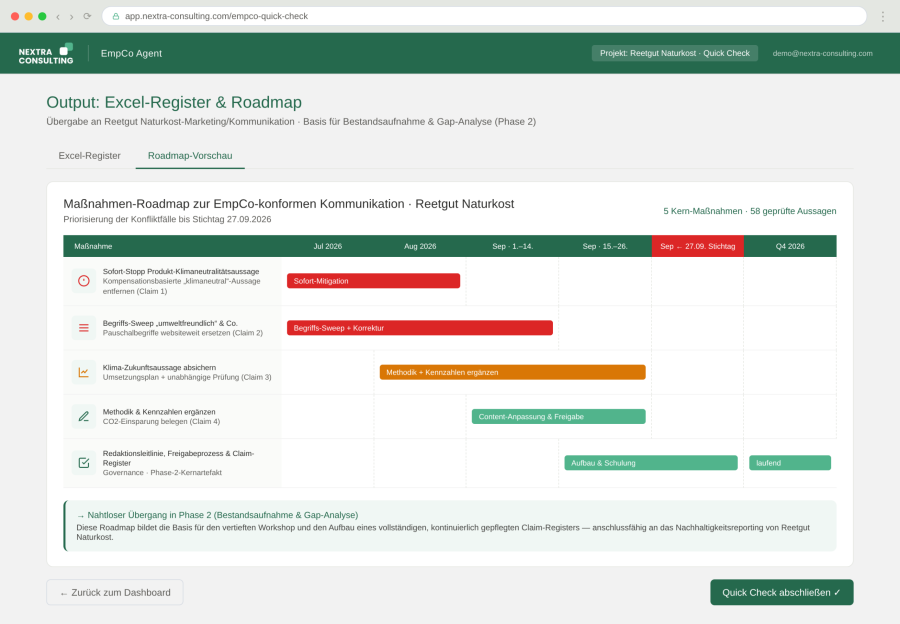
Handover-ready claims register plus a prioritised action roadmap up to the deadline of 2026-09-27.

Results

What the Quick Check includes

A clearly structured results package that provides a concrete path to EmpCo compliance.

AI screening of all sustainability claims

Systematic analysis of your public communication: website, press releases, reports, shop pages, and co-branding materials.

Claims register sorted by risk

Clear Excel register with all identified claims, organized by risk level (high, medium, low).

Detailed analysis by consultants

Each identified statement is professionally evaluated and classified by experienced sustainability consultants.

Three mitigation options per high-risk case

Tiered strategic action options from quick fix to structural solution for every critical statement.

Prioritised action roadmap

Timeline for all measures up to the deadline of 2026-09-27, with clear prioritization and responsibilities.

Handover workshop

Joint workshop with the relevant departments (marketing, CSR, communications) to hand over the results and next steps.

Services

Quick Check vs. baseline assessment

Two service levels for different starting points: from an initial overview to detailed implementation planning.

Recommended as an entry point

Quick Check

Fast, AI-powered overview of your risk situation

Data basis

Public sources

Methodology

AI-powered screening

Effort

2–3 weeks, fixed price

Output

Risk map with standard mitigations

Baseline assessment gap analysis

In-depth review with internal data analysis and a prioritised roadmap

Data basis

+ internal sources (LCAs, PCFs, strategies, …)

Methodology

Manual in-depth review + workshop

Effort

6–8 weeks, effort-based

Output

Prioritised roadmap per claim

Note

The EmpCo Quick Check is a screening and strategy tool for sustainability communication and a supplementary service to our sustainability consulting. It provides a professional risk indication from a sustainability perspective and does not replace legal advice. We do not provide legally binding assessments of individual statements within the meaning of the RDG.

Do you need a legally binding detailed review of individual claims? We can connect you with specialized partner law firms for environmental and competition law.

Do you have questions about implementing EmpCo?

We are here for you!

In a short initial consultation, we will clarify together what scope makes sense for your situation and how the Quick Check can be carried out in practice.

Dr. Martin Granzow
Managing Director and Founder of Nextra Consulting